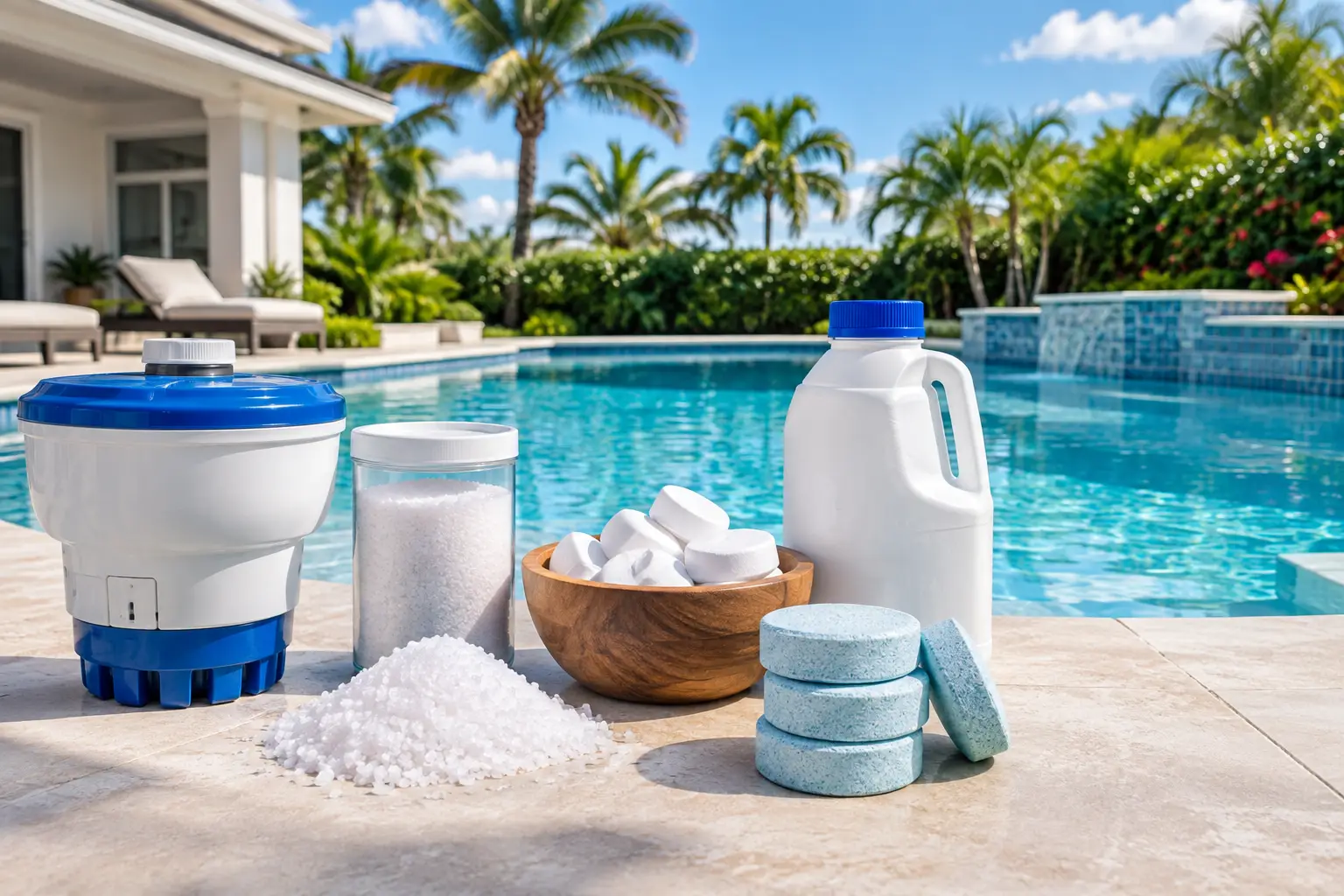
A floating feeder full of tablets can feel like the easiest way to keep a pool clean. But chlorine tablet alternatives are worth considering when cyanuric acid keeps climbing, the pool’s pH is drifting low, or you simply want more control over weekly water chemistry. The right choice is not always chlorine-free. In many cases, it is a better way to deliver chlorine while keeping water safe, clear, and comfortable.
For residential pools in western Palm Beach County, the answer also depends on sun exposure, bather load, pool finish, equipment, and how consistently the water is tested. Florida sunshine burns through unstabilized chlorine quickly, so changing products without a plan can create a new problem while solving an old one.
Why homeowners look for chlorine tablet alternatives
Most chlorine tablets are trichlor. They are convenient, concentrated, and stabilised, meaning they add cyanuric acid, often called CYA or conditioner, along with chlorine. They are also acidic, so regular use can gradually lower pH and total alkalinity.
That combination is not automatically bad. Tablets can be useful in the right situation, especially for short-term chlorination or pools that genuinely need more stabiliser. The trouble begins when they become the only sanitizer year after year. CYA does not evaporate or get used up like chlorine. As it rises, the pool needs a higher free-chlorine level to remain properly sanitized. Eventually, dilution through draining and refilling may be needed to bring it back into a manageable range.
Homeowners may also want an alternative because feeders and floaters can concentrate highly chlorinated water in one area. That is not ideal for every pool surface, skimmer, or piece of equipment. A careful water test and equipment review should come before changing methods.
Chlorine tablet alternatives that actually work
Liquid chlorine
Liquid chlorine, usually sodium hypochlorite, is one of the most straightforward alternatives to tablets. It adds chlorine without adding CYA or calcium, making it particularly useful when stabiliser is already elevated. It also has a high pH when added, although its overall effect on pH is often manageable with routine balancing.
The trade-off is consistency. Liquid chlorine is consumed daily by sunlight and swimmers, and it loses strength over time, especially when stored in a hot garage. A pool owner who doses manually needs to test often and add the correct amount regularly. For a professionally maintained pool, liquid chlorine allows precise adjustments based on the water test rather than relying on a feeder setting.
It is a practical option for pools with high CYA, green-pool recovery, new water, or any situation where tablet use needs to pause. It still requires safe storage and handling. Never mix pool chemicals or pour one chemical into a container that held another.
A saltwater chlorine generator
A saltwater pool is still a chlorine pool, but the chlorine is produced gradually from dissolved salt by a salt cell. This gives many homeowners a steadier sanitizer level and reduces the need to handle tablets week after week. When the system is sized correctly and the cell is clean, it can make routine pool care more predictable.
Salt systems are not maintenance-free. The cell needs inspection and occasional cleaning, salt levels must remain within the manufacturer’s range, and the system’s output must be adjusted for season, weather, and bather load. Saltwater pools also tend to drift upward in pH, so balancing remains part of normal service.
For homeowners who want less hands-on chemical dosing, a salt system can be a strong long-term fit. It is especially appealing for families who use the pool frequently and want water that stays turtly clean without constantly managing a floater. Before installation, the pool’s existing equipment, electrical setup, plumbing, and surface condition should be evaluated by a qualified pool professional.
Calcium hypochlorite
Calcium hypochlorite, often called cal-hypo, is another chlorine source that does not add cyanuric acid. It is commonly available as granular chlorine or in certain specialised feeders. Like liquid chlorine, it can help when CYA is too high.
Its limitation is in the name: it adds calcium. In areas with already hard fill water, repeated cal-hypo use can raise calcium hardness enough to contribute to scale on tile, heaters, salt cells, and other equipment. It is usually a better fit when calcium hardness is in range and being monitored closely.
Cal-hypo is not interchangeable with trichlor tablets. The two products must never be mixed, stored together, or placed in the same feeder. They have different chemical properties and need different handling procedures. For most homeowners, this is a product best managed through a planned maintenance routine rather than occasional guesswork.
Bromine for limited applications
Bromine is sometimes presented as a chlorine replacement, but it is generally better suited to spas and hot water than to outdoor swimming pools. It can provide reliable sanitation in warm water, yet it is not usually the first choice for a sun-exposed residential pool.
Because bromine chemistry behaves differently and can be more difficult to manage in a large outdoor pool, it is rarely the simplest answer for a Florida backyard. If a pool has been operated on chlorine, switching to bromine should be a deliberate system decision, not a quick substitute for tablets.
Mineral, UV, and ozone systems
Mineral systems, ultraviolet units, and ozone systems can improve a pool’s overall water quality program. They may reduce some sanitizer demand and can help address contaminants as water moves through the circulation system. They do not, however, replace the need for a measurable residual sanitizer in the pool water.
That distinction matters. UV only treats water that passes the lamp, and ozone is short-lived. Mineral cartridges can provide supplemental benefits, but they still need to be paired with properly maintained chlorine or another approved primary sanitizer. These systems work best as part of a complete equipment and chemistry plan, not as a promise of chemical-free pool care.
Choosing the right alternative for your pool
The best chlorine tablet alternative starts with test results, not a product label. Free chlorine, combined chlorine, pH, total alkalinity, CYA, calcium hardness, phosphates, and salt level where applicable all tell part of the story. The condition of the waterline, pool finish, heater, pump, filter, and feeder also matters.
If CYA is high but calcium hardness is already near the upper end, liquid chlorine may make more sense than cal-hypo. If the homeowner wants daily chlorination with less manual dosing, a properly selected salt system may be a better investment. If the pool is struggling with algae, the immediate priority may be a measured recovery process rather than a permanent sanitizer change.
Sunlight changes the calculation, too. A pool in full Florida sun needs enough CYA to protect chlorine, but not so much that chlorine becomes less effective. A pool shaded by a screened enclosure, trees, or a covered patio may consume sanitizer differently. There is no universal feeder setting or one-size-fits-all chemical schedule.
A balanced plan protects water and equipment
Switching away from tablets does not mean stopping routine testing. In fact, changing sanitizer methods is a good time to watch the water more carefully. Chemistry can shift during the first few weeks as old tablet-fed water is gradually replaced by a different source of chlorine.
A dependable weekly service program keeps those changes visible. Skimming, brushing, vacuuming as needed, filter and equipment observation, and accurate water testing all work together. Clear water alone is not proof that a pool is balanced or properly sanitized.
For homeowners in Wellington, Westlake, Royal Palm Beach, Loxahatchee and The Acreage, the most practical solution is often a customized mix of proper circulation, the right sanitizer delivery method, and consistent professional testing. Turtle Pool Care can help identify whether tablets are still serving your pool or quietly creating a chemistry issue that needs attention.
A pool should feel like the easy part of the backyard. With the right sanitizer plan and regular care, you can spend less time adjusting chemistry and more time enjoying water that is clear, comfortable, and ready when your family is.