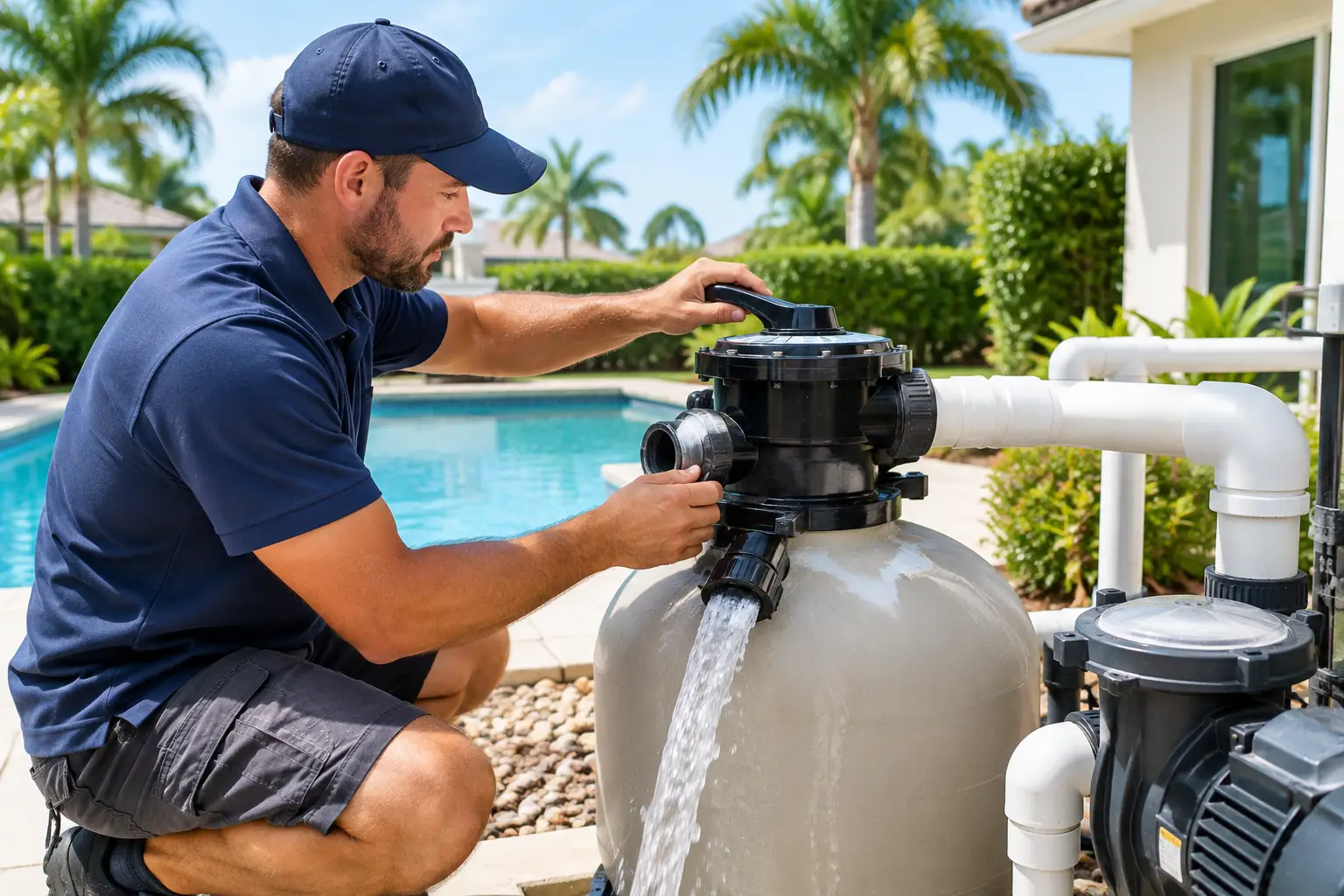
A pool can look clear at the surface while its filter is quietly working too hard underneath. Learning how to backwash pool filters helps protect circulation, reduce strain on the pump, and keep water moving through the system as it should. The key is not backwashing on a random schedule. It is knowing what type of filter you have, recording its clean pressure, and acting when the system tells you it is time.
For homeowners in Wellington, Royal Palm Beach, and nearby communities, that timing can change quickly after a windy week, heavy rain, frequent swimming, or a green-water recovery. A careful backwash can restore flow. An unnecessary one can waste water and, with a DE filter, reduce filtration performance.
First, confirm that your filter can be backwashed
Sand filters and diatomaceous earth, or DE, filters are designed to be backwashed. Cartridge filters are not. If your pool has a cartridge filter, reversing the water flow will not clean it properly and can damage the equipment. Cartridge elements need to be removed and rinsed according to the manufacturer’s guidance instead.
The easiest visual clue is the valve arrangement. Many sand and DE filters have either a multiport valve with labeled settings such as Filter, Backwash, Rinse, Waste, and Recirculate, or a push-pull valve that moves between filter and backwash positions. A cartridge filter generally does not have either backwash valve setup.
If labels are faded, plumbing has been modified, or you are not certain which filter is installed, pause before turning any valve. A quick confirmation can prevent an avoidable equipment issue.
The pressure gauge tells you when to backwash
Do not use the calendar as your main signal. Backwashing every week or every month just because it feels routine can send perfectly useful filtered water down the waste line. It may also interfere with a sand filter that has developed a helpful layer of trapped fine debris, which can improve filtration.
Instead, start with a clean-filter baseline. After the filter has been cleaned or backwashed, run the pump normally and note the pressure reading on the gauge. This is your clean operating pressure. Write it down somewhere accessible, such as inside the equipment panel or in your pool care records.
Most pools need backwashing when pressure rises about 20 to 25 percent above that baseline. For example, a filter that normally runs at 12 PSI may be ready for backwashing around 15 PSI. The exact number depends on the plumbing, pump speed, filter size, and how your pool is equipped.
Pressure is not the only clue. Weak return flow, a skimmer that is not pulling well, or a pump that sounds as though it is working harder than usual can also point to a loaded filter. Still, a high gauge reading deserves context. A damaged gauge, closed valve, dirty pump basket, or plumbing restriction can create confusing symptoms. Backwashing is not a cure-all.
How to backwash pool filters with a multiport valve
Before you begin, make sure the pool water level is high enough. Backwashing removes water from the pool, sometimes faster than homeowners expect. If the water is already low, add water first so the skimmer does not pull air into the system.
Also check where the backwash water will go. Confirm that the waste hose is secure and that drainage will not flood a landscaped area, affect a neighbor’s property, or violate local discharge rules.
Follow this process for a sand or DE filter with a multiport valve:
- Turn the pump off completely. Never move a multiport handle while the pump is running. The internal gasket can be damaged by pressurised water moving across it.
- Press down on the multiport handle and turn it to Backwash.
- Open any required waste line valve, if your plumbing has one.
- Turn the pump back on and watch the sight glass, if fitted. At first, the water may look cloudy or dirty. Let it run until it clears, usually about two to three minutes.
- Turn the pump off again. Move the valve to Rinse.
- Run the pump for roughly 20 to 30 seconds. Rinse settles the filter media and clears remaining debris from the valve and plumbing.
- Turn the pump off, return the valve to Filter, then restart the system.
Check the pressure gauge once flow has stabilised. It should be close to your normal clean-filter reading. If it remains unusually high, do not keep repeating the process indefinitely. There may be a restriction elsewhere, a problem inside the filter, or an inaccurate gauge.
Backwashing with a push-pull valve
A push-pull, sometimes called a slide valve, has fewer settings. With the pump off, pull the handle up or push it down according to the valve’s markings to place it in backwash mode. Run the pump until the discharge water clears, then turn the pump off and return the handle to the filter position before restarting.
Unlike a multiport valve, this setup does not always provide a separate rinse setting. Follow the valve and filter manufacturer instructions for your specific equipment. Do not force a stiff handle. O-rings and seals may need attention, and forcing the assembly can create a leak.
DE filters need one additional step
DE filters use fine diatomaceous earth powder to coat their internal grids. That coating captures very small particles and is a major reason DE filters can produce exceptionally clear water. During backwashing, much of that powder is flushed out along with the debris.
After backwashing a DE filter, the proper amount of fresh DE must be added through the skimmer while the pump is running and the system is set to Filter. Use the amount specified for your filter model, not a guess based on the size of the pool. Too little DE can allow debris to bypass the grids. Too much can restrict flow or contribute to buildup.
Handle DE carefully. Avoid breathing the dry powder, follow the product label, and keep it away from children and pets. If you are unsure of the filter’s required charge or suspect torn grids, it is best to have a pool professional inspect the system.
The most common mistake is turning the multiport valve while the pump is on. It takes only a moment, but it can damage the spider gasket inside the valve and cause water to bypass the filter later.
Another is backwashing too long. Once the sight glass is clear, extra run time is usually just wasted water. Conversely, stopping too early can leave debris in the media and provide little improvement in circulation.
Skipping the rinse cycle is also a problem on multiport systems. Without rinsing, loose debris and disturbed filter media can return to the pool through the return lines. The water may cloud up briefly, creating more work for the filter you just cleaned.
Finally, do not assume every cloudy pool needs a backwash. Cloudiness may come from poor water balance, early algae growth, fine suspended particles, inadequate run time, or a circulation issue. The filter is part of the solution, but healthy water depends on chemistry and circulation working together.
When backwashing is not enough
If pressure rises again soon after backwashing, or water quality does not improve, the filter may need deeper service. Sand can become channelled, calcified, or contaminated with oils. DE grids can tear, and internal manifolds can crack. A filter tank may also have worn valves, leaking clamps, or damaged air-relief components.
A professional inspection is especially worthwhile after a green-pool cleanup, a major storm, a prolonged period of poor circulation, or repeated algae issues. Those conditions can load a filter heavily and reveal underlying equipment concerns that a quick backwash cannot solve.
At Turtle Pool Care, detailed service reports and equipment checks help homeowners see more than just a clean waterline. A turtly clean pool also needs dependable circulation, balanced water, and a filter that is operating within its normal range.
A well-timed backwash should leave your pool with stronger flow, lower pressure, and one less thing to worry about before the next family swim. If the readings or water behavior still do not make sense, treating the issue early is usually far easier than waiting for a small filter problem to become a cloudy-pool weekend.