
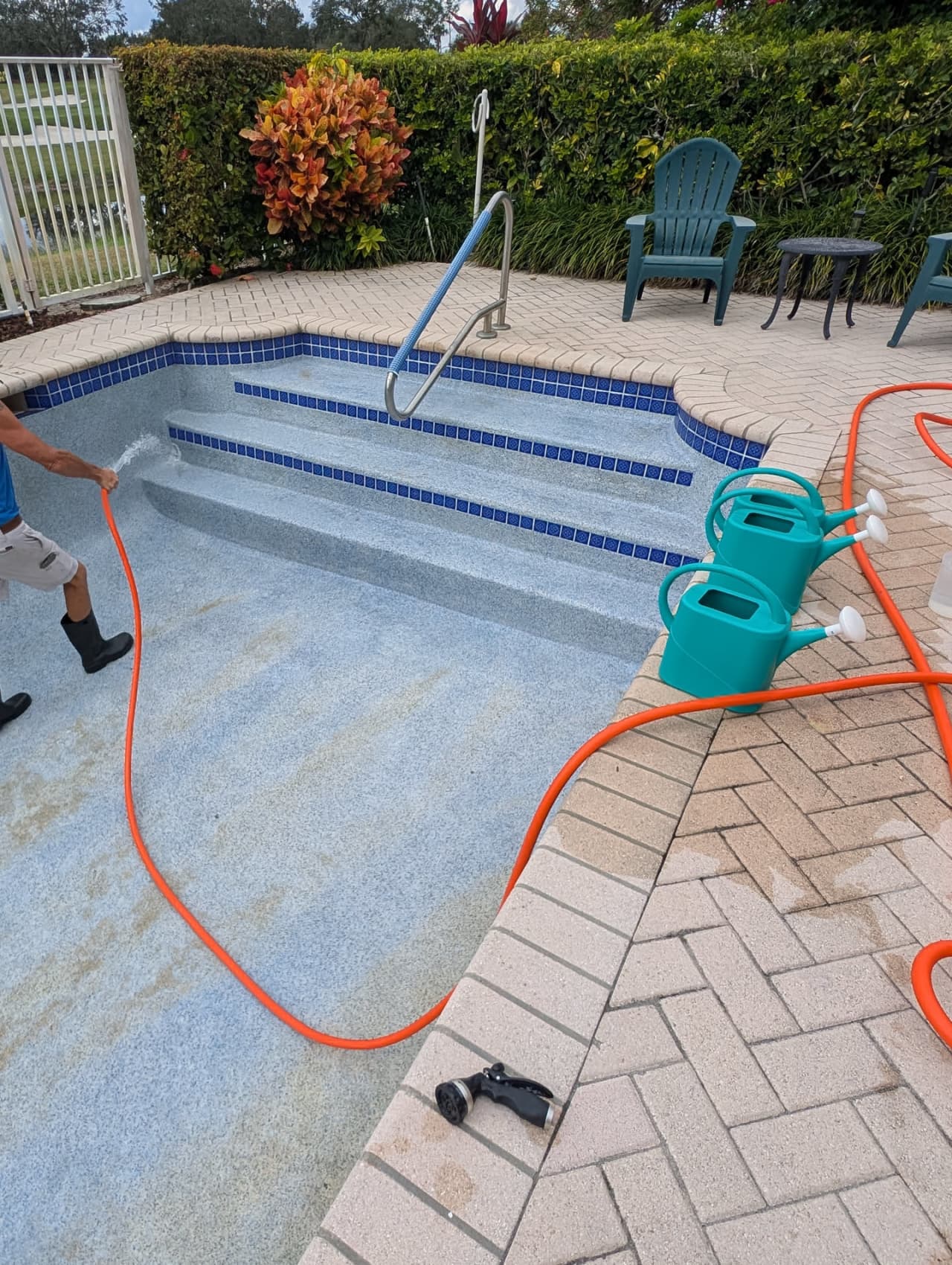
Pool Acid Washing & Stain Removal
Pool acid washing is a specialized surface-restoration service — and not every stain needs it. Brown, orange, green, white or dark stains on the pool surface? Turtle Pool Care identifies the likely cause first, then chooses the least aggressive effective treatment, from non-drain stain treatment to acid washing when the stain and surface justify it.
Serving Wellington, Westlake, Loxahatchee & The Acreage, Royal Palm Beach, Greenacres, Avenir, The Club at Ibis.
See the difference
Actual Turtle Pool Care stain-removal / acid-wash project. Drag to compare.


Drag the handle to compare the results.
What's that stain?
| Appearance | Possible causes | Common context |
|---|---|---|
| Rust-brown, orange or reddish | Iron or other metal staining | Well water, metal contamination, oxidized iron |
| Blue-green or turquoise | Copper or other metal-related staining | Heater components, copper-containing products, metal imbalance |
| White or crusty buildup | Calcium scale or mineral deposits | Scaling water conditions, hard / mineral-rich source water |
| Brown or tea-colored discoloration | Organic staining, tannins or metals | Leaves / organic material, tannin-rich source water, metals |
| Dark spots that do not brush off | Organic growth, metals, surface condition or other causes | Requires diagnosis rather than color alone |
Color alone is not enough to diagnose a pool stain. Turtle Pool Care looks at the water chemistry, source water, pool surface and response to spot testing before choosing treatment.
How we decide on the right treatment
1. Identify the stain
We evaluate the appearance, pool surface, water chemistry, source water and stain behavior before choosing treatment. Where applicable, Turtle may use targeted spot testing.
2. Use the least aggressive effective option first
Many metal or organic stains can be investigated and treated without draining the pool. When a non-drain treatment is likely to address the problem, Turtle Pool Care prefers that over unnecessarily removing surface material.
3. Acid wash only when the stain and surface justify it
A traditional acid wash removes a very thin layer of a cementitious pool surface along with embedded staining and scale. Because material is being removed, acid washing is not routine maintenance and should not be repeated casually. We reserve it for situations where the surface is suitable and less aggressive treatment is not the better option.
4. Address the source
Removing the visible stain is only part of the job. If the underlying source remains (such as iron in fill water, mineral accumulation or water-balance problems), the stain may return.
That's why we test before we treat.
Can the stain be treated without draining the pool?
Often, yes.
Many metal and organic stains can be investigated and treated while the pool remains full, depending on the stain type, surface and water condition.
Turtle Pool Care first determines whether a non-drain treatment is likely to work before recommending a traditional acid wash.
We do not promise that every stain can be removed without draining, and we do not publish a universal chemical recipe.
What an acid wash actually does
An acid wash is more aggressive than normal cleaning or stain treatment.
The acid removes a very thin portion of a suitable cementitious surface, exposing cleaner material underneath.
That can be effective for certain embedded stains, scale and discoloration, but it also means the condition and remaining life of the surface matter.
Acid washing is not safe for every finish and should not be repeated indefinitely.
Why draining a pool carries real risk
An empty swimming pool can behave like a boat.
When the pool is full, the weight of the water helps hold the shell in place. When the pool is empty and groundwater pressure around and beneath the shell is high enough, buoyancy can push upward on the empty or nearly empty pool.
The possible consequences can include flotation, shell movement, structural damage, or the pool lifting or “popping” out of the ground. This is commonly called pool pop-up or pool flotation.
That risk is one of the reasons Turtle Pool Care does not treat draining as a routine step.
We will postpone an acid wash when groundwater conditions are too high
Turtle Pool Care does not perform an acid wash simply because it is convenient to schedule.
Once rainy-season groundwater conditions are elevated, Turtle Pool Care postpones traditional acid-wash work that requires draining until surrounding water levels have visibly dropped and site conditions are suitable.
Nearby ponds, lakes, canals and saturated ground can provide important clues about local groundwater conditions.
If conditions are not safe enough to justify draining, we wait.
We do not promise a fixed seasonal start or end date, and not every rainy-season day is unsafe. We evaluate the actual conditions.
How we assess groundwater risk before draining
When practical, Turtle Pool Care compares the pool elevation with nearby ponds, lakes, canals or other visible water bodies using GPS/elevation information.
The relative elevation helps us judge whether groundwater may be close to the pool shell.
We combine that information with recent rainfall, visible surrounding water levels, saturated-ground conditions and what we know about the property.
GPS/elevation comparison is a risk-assessment tool, not a direct measurement of the water table. We do not claim precise groundwater depth from GPS.
Pool pop-up waiver
Draining a swimming pool carries a groundwater-related risk that cannot be completely eliminated.
Turtle Pool Care's insurance requires the property owner to sign a pool pop-up waiver before the pool is drained for an acid wash or other service requiring a full drain.
We explain the reason for the waiver before work begins so the customer understands the risk rather than simply receiving a legal form without context.
The waiver does not eliminate responsibility or guarantee safety.
Well water, iron and recurring stains
Some pools supplied or topped off with well water can accumulate iron, calcium and other dissolved minerals.
Iron can create rust-brown or orange staining, while tannins can create brown or tea-colored discoloration.
Iron and tannins are different problems and require different treatment.
Removing the visible stain without addressing the source can allow the discoloration to return. Not every well-water pool has iron or tannins.
White scale and mineral buildup
White or crusty deposits may be associated with calcium scale or other mineral buildup.
Scaling potential depends on the overall water balance, including calcium hardness, pH, alkalinity, temperature and source-water conditions.
Repeated top-off with mineral-rich well water can increase dissolved mineral concentration over time as water evaporates and the minerals remain behind.
Calcium alone does not determine scale.
Removing the stain is only half the job
The best long-term result comes from addressing both the visible stain and the condition that caused it.
- Managing source-water metals
- Water-balance correction
- Reducing scaling potential
- Appropriate sequestration where used
- Avoiding repeated introduction of problem source water where possible
- Regular water testing
- Ongoing weekly maintenance
We do not prescribe one universal product or treatment.
Surface condition matters
Traditional acid washing is intended for suitable cementitious pool surfaces and is not a universal treatment for every pool finish.
Before recommending it, Turtle Pool Care evaluates the surface type, condition and likely stain depth.
For surfaces that are not suitable for traditional acid washing, other stain-treatment methods may be considered instead.
We do not claim to acid-wash fiberglass, vinyl or painted pools.
When acid washing isn't enough
Acid washing can improve certain stains and scale, but it cannot restore a surface that is structurally worn, deeply deteriorated or beyond what stain removal can reasonably correct.
When the surface condition makes resurfacing the more appropriate long-term solution, Turtle Pool Care will explain that rather than repeatedly removing more material with another acid wash.
Turtle Pool Care does not perform resurfacing unless that is separately confirmed as an offered service.
After an acid wash
After the pool is refilled, the water and surface need careful attention as the pool returns to normal operation.
Turtle Pool Care can manage the refill chemistry and transition the pool back into normal maintenance based on the surface and actual water conditions.
We do not use one universal refill or startup timeline.
Pool stain removal in your area
Acid Washing & Stain Removal questions
Answers to common questions about this service.
Related services

Professional water testing and chemical balancing for healthy pool water.
Learn more
Startup care for new or resurfaced pools.
Learn more
Green pool cleanup and algae removal for green, cloudy, algae-affected, or neglected pools.
Learn more
Dependable weekly pool care with water testing, chemical balancing, and documented visits.
Learn more
Diagnosis and repair of pool pumps, filters, valves, plumbing, and more.
Learn moreWhat our customers say
Not sure what is staining your pool?
Send us photos and information about the pool, surface, water source and how long the staining has been present. Turtle Pool Care will evaluate the likely cause before recommending treatment.
If a traditional acid wash would require draining the pool, groundwater and pop-up risk are evaluated before the work is scheduled.